
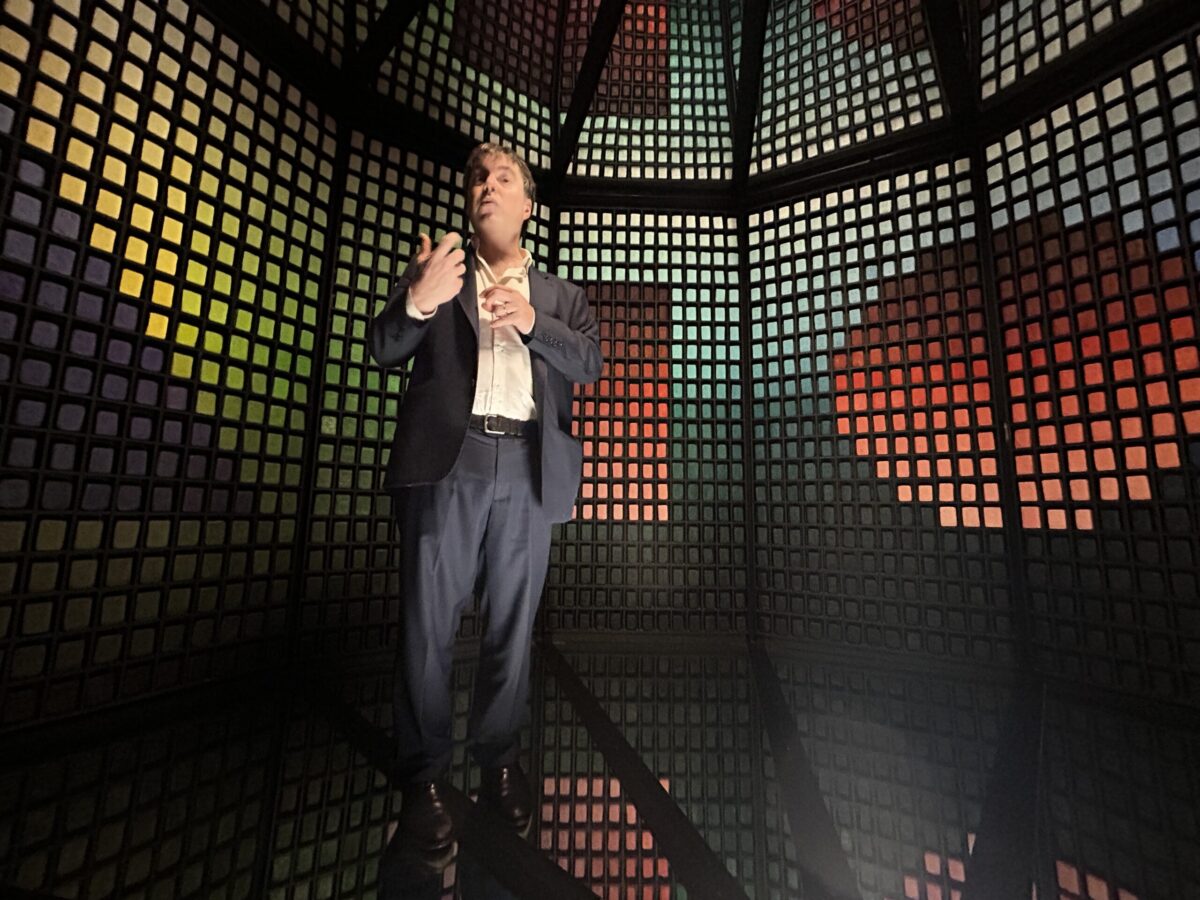
Por Valeria Massimino
Hablar con Andrés Buhar no fue una entrevista en el sentido clásico, sino algo más cercano a una conversación abierta. No hubo un orden rígido de preguntas y respuestas, sino una charla que se fue desplegando con naturalidad, casi como una obra en proceso. Las ideas aparecían, se conectaban entre sí y abrían nuevos caminos. Como suele pasar cuando se habla de arte, una palabra llevaba a otra, una reflexión a una imagen, y de ahí a una pregunta más amplia. La conversación avanzaba sin necesidad de cerrarse, dejando la sensación de que siempre había algo más por pensar, un loop posible, infinito.
Hablar de arte, inevitablemente, es filosofar. No desde un lugar solemne, sino como algo bastante natural: preguntarse por lo que creamos, por lo que consumimos y por el sentido de todo eso. La charla con Buhar se movía ahí, entre lo concreto y lo abstracto, sin forzar nada. Al final, todo volvía a lo mismo: la experiencia real, lo que nos pasa. Y quizá esa sea la única pregunta que importa, aunque mejor no abrirla demasiado, porque podría no terminar nunca.
Entre anécdotas, ideas y proyectos, aparecía esa reflexión constante sobre el lugar del arte hoy, su necesidad y su capacidad de abrir espacios; físicos y simbólicos, para pensar y sentir, quizá, de otra manera.
Cuando escuché por primera vez sobre Arthaus sentí esa mezcla rara de sorpresa y entusiasmo: eso que solemos admirar cuando viajamos y vemos en otras ciudades del mundo, pero que ahora existe acá, en pleno microcentro porteño. No es solo un lugar que alberga arte, sino un espacio donde el arte se vive como experiencia. Una propuesta singular en Buenos Aires, difícil de comparar.
Buhar cuenta que la idea tomó forma en plena pandemia: ese paréntesis global que detuvo el ritmo de todo, también abrió un tiempo inesperado para imaginar. “No hay que sobrepensar”, dice. Y la frase resuena porque va a contramano de esa parálisis que a veces generan las ideas cuando se quedan girando en la cabeza. La clave, sugiere, es hacer: accionar, bajar lo imaginado a tierra. Arthaus nació, en parte, de un impulso creativo: la necesidad de transformar la pausa en movimiento. Incluso reflexiona que, sin aquel contexto extraordinario, quizás el proyecto no existiría tal como lo conocemos hoy.
Y de pronto resuena la frase de David Thoreau: «Si has construido castillos en el aire, tu trabajo no tiene por qué perderse; ahí es donde deben estar. Ahora coloca las bases debajo de ellos».
La conversación se movía como el arte mismo: una palabra llevaba a un recuerdo, una imagen abría otra reflexión. Pensar el arte hoy, en estos tiempos cada vez más líquidos, como anticipó Zygmunt Bauman, implica preguntarse por su lugar: qué dice, cómo circula y de qué manera sigue dialogando con nuestra experiencia cotidiana.
Los números dicen que cada vez menos gente va al cine. Y la pregunta se extiende: ¿qué pasa con las exhibiciones de arte? En ese contexto, espacios como Arthaus proponen otra lógica. No se trata solo de programar música, teatro o cine, sino de experiencias que invitan a habitar el arte de otra manera: ver una película desde una terraza, por ejemplo, sentado en una reposera, dejando que la obra dialogue con el entorno. Más que competir con las pantallas, la apuesta parece ser recuperar el encuentro y convertirlo en experiencia.
Hay algo casi mágico en el lugar, y no es casual. Cuando el arte se vive de cerca aparece esa sensación de descubrimiento, como si cada detalle abriera una nueva lectura. En la charla surgieron referencias que iban de obras icónicas a colectivos como Mondongo, ligado a una experiencia personal de Buhar: una obra que, más allá de cualquier valor, lo emociona. En ese gesto se entiende que para él el arte es un vínculo vivo: algo que te toca, te acompaña.
“El verdadero viaje de descubrimiento no consiste en buscar nuevos paisajes, sino en tener nuevos ojos.” Marcel Proust
Hablar con él fue confirmar que Arthaus no es solo un espacio cultural: es una forma de pensar cómo queremos habitar el arte hoy. En su discurso aparece una convicción clara: el arte tiene que seguir vivo, incomodar, exigir, convivir con nosotros como una presencia activa.
Volver a su infancia ayuda a entender el mapa: la empresa era herencia; la música, refugio y una forma temprana de libertad (qué es la libertad es otra conversación). Hoy esas dos dimensiones conviven. Compone cuando puede, sin romantizar el proceso, sabiendo que crear también es administrar el tiempo. También rescata la vitalidad cultural argentina, capaz de producir con intensidad incluso en contextos adversos.
La pasión aparece como motor, pero no basta por sí sola. Andrés Buhar no habla de suerte ni de recetas; más que entusiasmo, transmite seguridad: dice lo que piensa con la claridad de quien sabe lo que defiende, sin pretender que sea la verdad absoluta.
Buhar sonríe ante la idea de planificación extrema. Arthaus nació hace pocos años y emociona. Dice que, en realidad, no lo pensó demasiado. Hoy reconoce que está contento de que el proyecto funcione, pero su mirada nunca se queda en lo que ya logró. No hubo una certeza previa de éxito ni un cálculo: más bien una decisión de avanzar. “No pensé mucho. A veces me preguntan si imaginé que iba a ser así… y la verdad es que no. Me gusta que funcione, claro, pero ya estoy pensando en lo que sigue, en qué sumar, en cómo expandir. Nunca me detuve demasiado en si iba a salir bien. Simplemente lo hice.”
¿Cómo cambia nuestra forma de entender el arte hoy, en un contexto atravesado por redes y transformaciones constantes?
A.B: El arte es un concepto work in progress. El arte no es algo fijo sino un concepto en permanente transformación: se construye, se discute y se redefine con el tiempo. Lo que hoy consideramos arte quizás años atrás no lo hubiera sido, porque nuestra mirada cambia, y justamente ahí radica su potencia. El arte trabaja sobre cómo vemos el mundo y cómo nos vemos a nosotros mismos. Frente a la pregunta clásica de para qué sirve, marca una diferencia con los saberes técnicos: mientras la ingeniería o la arquitectura resuelven problemas concretos, el arte opera en otro plano.
La banana
La obra creada por el artista italiano Maurizio Cattelan, consiste en una banana real pegada a una pared con cinta plateada acompañada de un certificado de autenticidad que permite reemplazar la fruta. Fue subastada en Nueva York por Sotheby’s por $6.2 millones de dólares. El empresario Justin Sun compró la obra y, poco después, se comió la banana en una conferencia de prensa.
Buhar la lee como un gesto cargado de ironía: una fruta común, casi un chiste, que se pudre rápido, atada con cinta de la manera más precaria posible y agrega: “Todo ahí contradice la idea clásica de obra duradera, hecha de bronce o mármol para la eternidad. En cambio, esto existe sabiendo que va a desaparecer. La tensión crece cuando esa pieza efímera se subasta por millones: ¿qué se está comprando realmente? ¿El objeto, la idea, la experiencia? Ahí aparece el juego del arte conceptual, que no busca solo ser contemplado sino activar una pregunta. Más que ofrecer una respuesta, la obra funciona como disparador: nos obliga a revisar qué entendemos por valor, por materialidad y por experiencia”.
Cómo logra una obra generar reflexión y abrir debate sin buscar solo provocar? Recuerdo la obra de León Ferrari, «La civilización occidental y cristiana”.
A.B: La obra de León Ferrari en su momento generó debate; hacía tiempo que no se hablaba tanto de un artista por lo que había hecho. Y eso también es parte del juego, buscar la provocación, o decidir no hacerlo. Porque la provocación no es una sola cosa: es un territorio amplio. A veces provocar por provocar no conduce a nada; otras, aparece una obra que sí logra abrir algo y generar sentido. Por eso es difícil generalizar fuera de contexto, y más aún sin saber qué puede pasar mañana. En ese marco, muchas veces lo más interesante no es solo la obra en sí, sino el debate que despierta. Para mí, lo verdaderamente complejo no es la provocación… es la indiferencia.
¿Qué implica hoy hablar de arte ‘elitista’ y arte ‘popular’?
A.B.: Hablar de elitismo y de lo popular implica reconocer que no todos partimos del mismo lugar. Cada persona enfrenta realidades, tiempos y urgencias distintas, y eso condiciona el espacio que tiene para acercarse al arte o simplemente disfrutarlo. Comprender algo, o tener el tiempo para hacerlo, también depende de qué necesidades básicas estén resueltas en la vida cotidiana.
Por eso me cuesta cierta idea de meritocracia que supone que todos competimos en igualdad de condiciones. No es lo mismo el valor del dinero ni del tiempo cuando está en juego lo básico que cuando eso ya está garantizado. Si yo tengo 10.000 pesos y de eso depende que hoy pueda comer, ese dinero vale todo: vale la vida. En cambio, si esa necesidad está cubierta, la misma plata puede convertirse en un gusto o un viaje. Ahí se ve claramente cómo cambian las prioridades. Lo mismo pasa con el tiempo y la tranquilidad: no todos disponemos del mismo margen para parar, disfrutar o simplemente darnos un respiro.
¿Cómo impactan la inteligencia artificial y la aceleración tecnológica en nuestra forma de pensar y percibir el mundo?
A.B.: No me preocupa la herramienta en sí, sino la velocidad con la que todo ocurre. Ese ritmo constante puede erosionar nuestra capacidad de procesar lo que vivimos, y ahí es donde la subjetividad empieza a diluirse. El arte es un lugar para frenar, pensar y recuperar una mirada propia.
A veces lo comparo con el choque entre sociedades que se encontraban con transformaciones tan abruptas que no había tiempo para asimilarlas ni construir un marco simbólico para entenderlas. Algo parecido pasa hoy con nuestra percepción del tiempo. En el siglo XX, avances como el auto o el avión cambiaron la experiencia de la velocidad, pero había un período de adaptación. Hoy todo parece acelerarse sin pausa: contenidos que cambian cada segundos, plataformas diseñadas para sostener una atención fragmentada, incluso películas pensadas sabiendo que el espectador mira el celular. Todo eso modifica nuestra relación con el tiempo y plantea una pregunta de fondo: ¿cuál es nuestro tiempo interno frente a esta aceleración constante?
Hace un siglo el trabajo era también físico: caminar, levantar, construir, cosechar… el cuerpo gastaba energía de forma natural. Cuando ese esfuerzo desapareció, aparecieron los gimnasios para compensarlo. Entonces me pregunto si no necesitamos algo parecido para la mente: una especie de gimnasio intelectual, porque cada vez ejercitamos menos el pensamiento. Y ahí hay un desafío real.
¿Cómo se construye una mirada propia frente a una obra en un contexto dominado por algoritmos y opiniones externas?
A.B: Reconocer qué te pasa frente a una obra es, en el fondo, un ejercicio de mirada crítica y de afirmación personal. No alcanza con decir “me gusta” o “no me gusta”: Se trata de entender desde qué lugar miramos. Esa diversidad de posiciones es valiosa porque amplía la percepción y no debería vivirse como confrontación. El conflicto aparece cuando la lógica de las redes reduce esa pluralidad a likes, algoritmos y nichos que refuerzan certezas en lugar de abrir preguntas. Recuperar espacios donde la diferencia pueda convivir sin agresión, y donde la experiencia sea más intercambio que consumo, se vuelve entonces una forma de preservar una mirada propia.
Buhar no da un consejo explícito, pero sugiere no quedarse paralizado por la búsqueda de genialidad o la validación externa. Recomienda partir de algo que despierte interés y explorarlo, observando qué te provoca en el proceso. Crear, insiste, es un misterio que se sostiene en la curiosidad y la autenticidad: no se trata de perseguir resultados, sino de encontrar un vínculo verdadero con lo que uno hace y dejar que eso marque el camino.
Web: arthaus.ar
IG: arthauscentral
🇬🇧 English
Andrés Buhar and Arthaus: How to inhabit art today
by Valeria Massimino
Talking with Andrés Buhar didn’t feel like a traditional interview so much as an open-ended conversation. There was no rigid sequence of questions and answers, but a dialogue that unfolded naturally, almost like a work in progress. Ideas surfaced, connected, and opened new paths. As often happens when discussing art, one word led to another, one reflection to an image, and from there to a broader question. The conversation moved forward without needing closure, leaving the sense that there was always more to think about, a possible, endless loop.
To talk about art is, inevitably, to philosophize. Not from a solemn place, but as something quite natural: questioning what we create, what we consume, and the meaning behind it all. The exchange with Buhar moved in that space, between the concrete and the abstract, without forcing anything. In the end, everything circled back to the same point: lived experience, what actually happens to us. And perhaps that is the only question that matters, though it’s better not to open it too far, because it might never end. Between anecdotes, ideas, and projects, a constant reflection emerged about the place of art today, its necessity and its ability to open spaces, both physical and symbolic, for thinking and feeling in new ways.
When I first heard about Arthaus, I felt that unusual mix of surprise and excitement: the kind of thing we admire when traveling and seeing cultural spaces in other cities, except this one exists here, in downtown Buenos Aires. It’s not simply a venue that houses art, but a space where art is experienced. A singular proposal in the city, difficult to compare.
Buhar explains that the idea took shape during the pandemic , that global pause that halted everything and unexpectedly opened time to imagine. “Don’t overthink it,” he says. The phrase resonates because it runs counter to the paralysis that ideas sometimes produce when they keep spinning in our heads. The key, he suggests, is to act, to bring imagination down to earth. Arthaus was born, in part, from that creative urgency: the need to transform pause into movement. He even reflects that without that extraordinary context, the project might not exist as we know it today.
Suddenly, a line by Henry David Thoreau echoes the spirit of that moment:
“If you have built castles in the air, your work need not be lost; that is where they should be. Now put the foundations under them.”
The conversation moved like art itself: one word led to a memory, an image opened another reflection. Thinking about art today, in these increasingly liquid times, as anticipated by Zygmunt Bauman, means asking where it stands: what it says, how it circulates, and how it continues to dialogue with everyday experience.
The numbers suggest fewer people are going to movie theaters. The question expands: what about art exhibitions? In that context, spaces like Arthaus propose another logic. It’s not only about programming music, theater, or film, but about creating experiences that invite people to inhabit art differently, watching a movie from a rooftop terrace, for instance, sitting in a lounge chair, letting the work converse with its surroundings. Rather than competing with screens, the aim seems to be recovering shared presence and turning it into experience.
There’s something almost magical about the place, and it isn’t accidental. When art is lived up close, a sense of discovery appears, as if each detail opens a new reading. During the conversation, references ranged from iconic works to collectives like Mondongo, connected to a personal experience of Buhar’s: a piece he acquired that moves him beyond any market value. In that gesture, it becomes clear that for him art is a living bond, something that touches you and stays with you.
A line by Marcel Proust captures that idea:
“The real voyage of discovery consists not in seeking new landscapes, but in having new eyes.”
Talking with him confirmed that Arthaus is not just a cultural venue, it’s a way of thinking about how we want to inhabit art today. His discourse carries a clear conviction: art must remain alive, capable of unsettling, demanding, and coexisting with us as an active presence.
Looking back at his childhood helps map that trajectory: business was inheritance; music was refuge and an early form of freedom (what freedom means is another conversation). Today, those dimensions coexist. He composes when he can, without romanticizing the process, aware that creating also means managing time. He also highlights Argentina’s cultural vitality, its capacity to produce intensely even under adverse conditions. Passion appears as an engine, but not enough on its own. Buhar doesn’t talk about luck or formulas; more than enthusiasm, he conveys assurance, speaking with the clarity of someone who knows what he stands for without presenting it as absolute truth.
He smiles at the idea of extreme planning. Arthaus is only a few years old and already emotional for him. He admits he didn’t overcalculate. Today he’s happy the project works, but his gaze never lingers on what’s already achieved. There was no certainty of success, just a decision to move forward. “I didn’t think too much. Sometimes people ask if I imagined it would be like this… honestly, I didn’t. I’m glad it works, of course, but I’m already thinking about what comes next, what to add, how to expand. I never stopped to wonder if it would turn out well. I just did it.”
How does our understanding of art change today, in a context shaped by networks and constant transformation?
A.B.: Art is a work in progress. It isn’t fixed; it’s continuously built, debated, and redefined over time. What we consider art today might not have been recognized as such years ago, because our gaze evolves, and that’s precisely its strength. Art works on how we see the world and ourselves. Faced with the classic question of usefulness, it differs from technical disciplines: while engineering or architecture solve concrete problems, art operates on another plane.
The banana
The work created by Maurizio Cattelan consists of a real banana taped to a wall with silver duct tape, accompanied by a certificate of authenticity allowing the fruit to be replaced. It was auctioned in New York by Sotheby’s for $6.2 million. Entrepreneur Justin Sun purchased the piece and later ate the banana at a press conference.
Buhar reads it as an ironic gesture: an ordinary fruit (almost a joke) that rots quickly, attached in the most precarious way. “Everything contradicts the classical idea of a durable artwork meant to last forever. This exists knowing it will disappear. The tension grows when something ephemeral sells for millions: what are you really buying, the object, the idea, the experience? That’s where conceptual art activates a question. Rather than offering answers, it pushes us to rethink value, materiality, and experience.”
How can an artwork provoke reflection and debate without simply seeking provocation? Thinking of León Ferrari’s La civilización occidental y cristiana
A.B.: Ferrari’s work sparked enormous debate; it had been a long time since an artist generated that level of discussion. Provocation is part of the game, whether you seek it or not, but it isn’t a single thing. Sometimes provocation leads nowhere; other times it opens meaning. Context matters. Often what’s most interesting isn’t the piece alone, but the conversation it creates. For me, the real challenge isn’t provocation, it’s indifference.
What does it mean today to talk about “elitist” versus “popular” art?
A.B.: It means recognizing we don’t all start from the same place. People face different realities, urgencies, and time constraints, which shape their access to art. Understanding something, or having time for it, depends on basic needs being met. That’s why meritocracy can be misleading. Money and time don’t hold the same meaning when survival is at stake. If I have money that determines whether I eat, that’s life itself. If that need is covered, the same amount becomes leisure. The same applies to time: not everyone has the same margin to pause and enjoy.
How do artificial intelligence and technological acceleration impact our thinking?
A.B.: The tool doesn’t worry me, the speed does. Constant acceleration erodes our ability to process experience, and subjectivity begins to blur. Art becomes a space to slow down and recover perspective. It reminds me of historical moments when societies encountered abrupt change without time to assimilate it. Today, content cycles in seconds, platforms fragment attention, even films assume viewers check their phones. It alters our relationship with time and raises a question: what happens to our inner tempo? A century ago, physical labor naturally exercised the body; now we use gyms. Perhaps we need intellectual gyms, because we’re exercising thought less and less.
How do we build an independent gaze in an algorithm-driven culture?
A.B.: Recognizing what happens to you in front of an artwork is an act of critical awareness. It’s not enough to say “I like it” or “I don’t.” You need to understand where your perspective comes from. Diversity of viewpoints expands perception. The problem arises when networks reduce that plurality to likes and niches reinforcing certainty. Preserving spaces where difference can coexist, where experience is exchange rather than consumption, is essential to maintaining a personal gaze.
Buhar doesn’t give a strict formula, but suggests not freezing in pursuit of genius or external validation. Start with something that sparks interest and explore what it awakens. Creation, he insists, is sustained by curiosity and authenticity. It’s less about chasing results than building a real relationship with what you do, and letting that guide the path.
Web: arthaus.ar
IG: arthauscentral
Amo que en Buenos Aires podamos tener algo asi
Excelente Nota Vale, revista Meta. El arte 🎭🎨 es espectacular. Es real que todos no lo ven con los mismos ojos.